
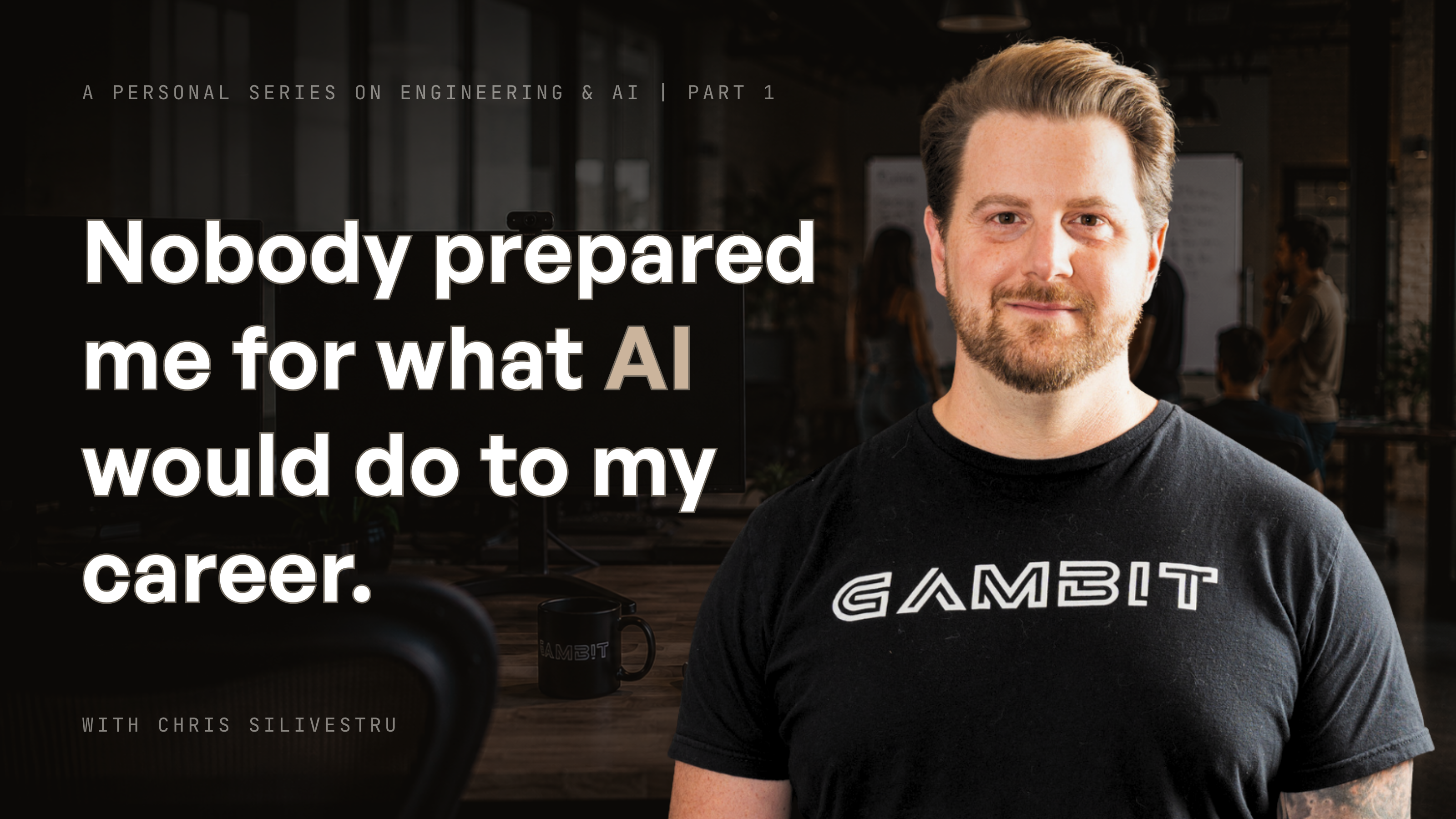
Back in April, I took two weeks off and went to Greece with my family. I set some boundaries with the team before the trip and only checked in if something really needed me. Luckily, it wasn't often. This was the first time in a long while I'd properly unplugged from my job, and it was bliss.
I came back on a Monday. And sometime that first morning in the office, Ryan showed me what he'd been working on while I was away. An entire sales platform, built entirely from scratch for a client. And it was good. Like, really good. A build like that used to take an engineer a few weeks, and Ryan had put it all together in days.
Ryan isn't the builder. That was never his job. Ryan is our creative force, the one who makes what we build feel human, who cares about how it feels to use. Pat (our CEO) sells the art of the possible. I build it. That's been the arrangement since we started Gambit in 2023, and none of us ever questioned it. And now Ryan had gone and built a whole platform on his own, with no engineer involved at any point.
So how did he do it? He didn't learn to code while I was in Greece. He did it because AI tools got so good that he didn't have to.
And it's not just Ryan. The part I used to be needed for, the building itself, is something almost anyone at Gambit can do now. Someone who a year ago would have written up what they wanted and waited for me can just make it themselves. Even our Head of Content has started building her own tools.
For years the bottleneck was me. And it took one vacation to see that wasn't true anymore.
I didn't say much when Ryan showed me his work. I was glad for him, and pretty freaking impressed. But underneath that was something I didn't have a word for yet. For my whole career, being the best builder in the room was the thing that made me valuable. And what Ryan built was the first sign that you didn't necessarily need the best builder in the room anymore.
If you're a CTO or a VP of Engineering, I think you already know this feeling, or you're about to. And the writing out there for us is useless on exactly this topic. Half of it is generic advice about leading through change. The other half is someone three layers deep on which model to use for what. Almost none of it gets at what's actually going on.
AI didn't just change our tools, it changed what we're for. And that's a strange thing to sit with when building was what you were known for.
I've spent the months since that Monday figuring out what my job even is now, and I've gotten plenty of it wrong. My first instinct was to hold on tighter. Review everything, insert myself back into work that was moving along fine without me. All that did was turn me back into the bottleneck I'd just stopped being. So I swung the other way and went back to writing code.
Code gives you a clean answer at the end of the day, and the job I'm supposed to be doing now doesn't. It felt productive. But mostly I was avoiding the harder thing, which was figuring out what I'm for when I'm not the one building. I knew it while I was doing it. I'm still working out where I'm useful now.
So that's where I'm at. An engineer who spent years being the one who builds, now trying to work out where I fit in a company where AI means everyone can do what I used to do. And I know I'm not the only one in this position. A lot of us came up as the technical person, the one who could always just make the thing, and AI has changed what that's worth.
Nobody really talks about that part, so I'm going to. I want to go back to who I was before any of this, walk through the moment it changed, be honest about how I've been adapting since, and try to work out where it leaves us.
Because underneath all of it is one question I can't shake: where do you fit when the thing you were best at doesn't need you as much anymore?
If you're asking yourself the same question, I hear you, and you're not alone. Stick with me as I write through it. I don't have the answers yet, but I think the conversation is worth having, and almost no one is.
